About
MathEXLab regularly organizes seminars that bring external speakers to share their latest research with the lab and the broader community. These talks span the core themes of the group and create space for discussion across applied mathematics, physics, machine learning, and scientific computing.
In addition to invited talks, we also run an internal seminar series where members of the lab present their ongoing research in the form of 30-minute talks. These sessions are intended to encourage feedback, discussion, and exchange across projects within MathEXLab.
Internal Seminar Series
Details of the internal MathEXLab seminar series will be added here. These seminars feature 30-minute research talks by lab members on ongoing work, recent results, and new ideas in progress.
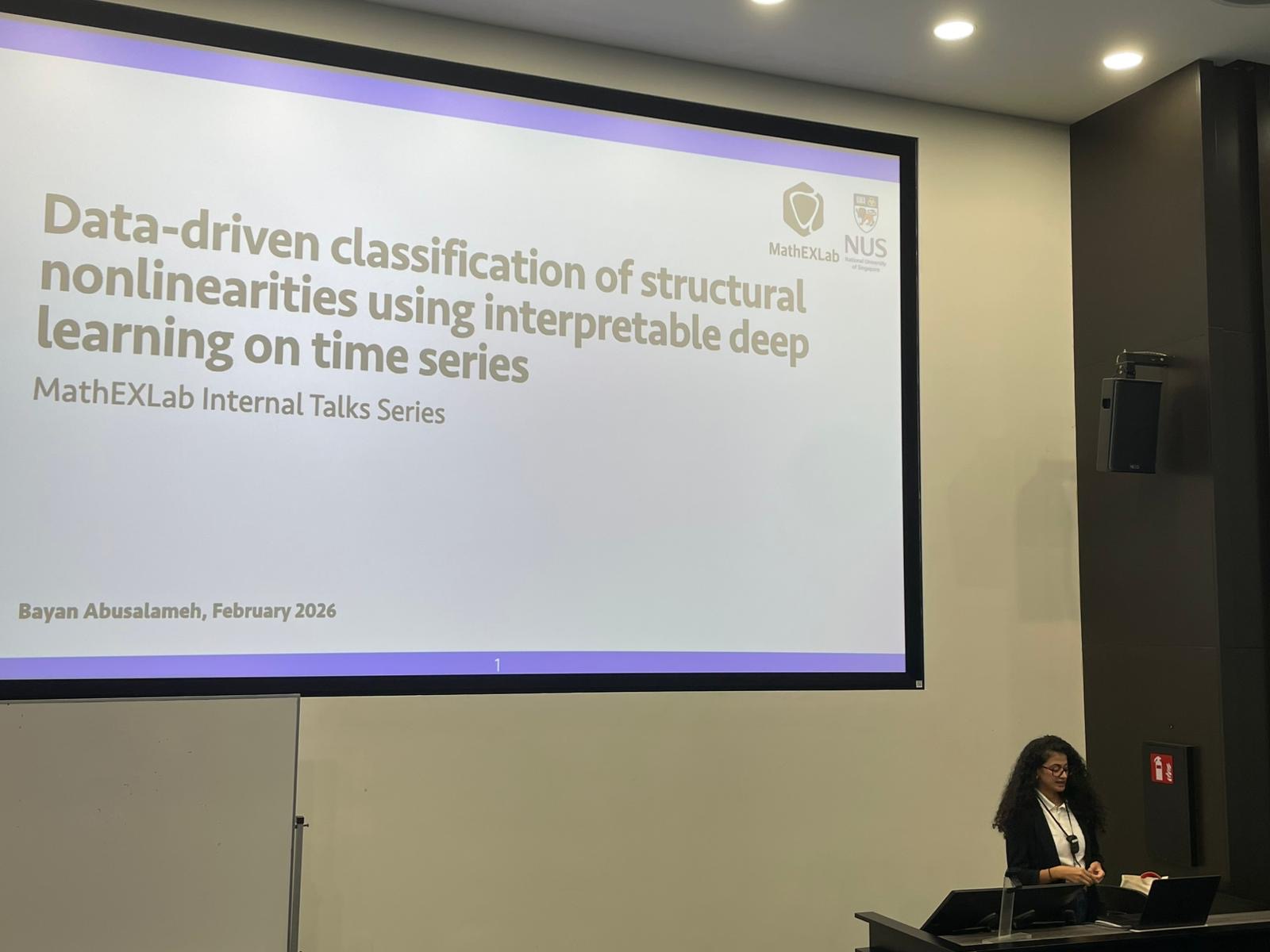
Interpretable AI for Nonlinear Structural Dynamics and a Benchmark for Nonlinear Mode Interaction
In this internal seminar, Bayan Abusalameh presented her ongoing research on interpretable AI for nonlinear structural dynamics and benchmark design for nonlinear mode interaction.
Seminar Details
- Speaker: Bayan Abusalameh
- Role: PhD Student, MathEXLab
- Date: 24 February 2026
- Time: 2:00 pm (SGT)
Abstract
- She introduced a large controlled dataset for detecting nonlinearities in vibrating structures directly from raw time-series signals, together with a post-hoc interpretability pipeline based on Integrated Gradients, DeepLIFT, GradientSHAP, and DeepSHAP, as well as new quantitative metrics for testing attribution fidelity.
- She also presented a large-scale benchmark for nonlinear mode interaction in two-degree-of-freedom oscillators, designed to support reproducible study of resonance, detuning, damping, nonlinear strength, forcing, and early interaction detection in complex physics-based systems.
External Seminars
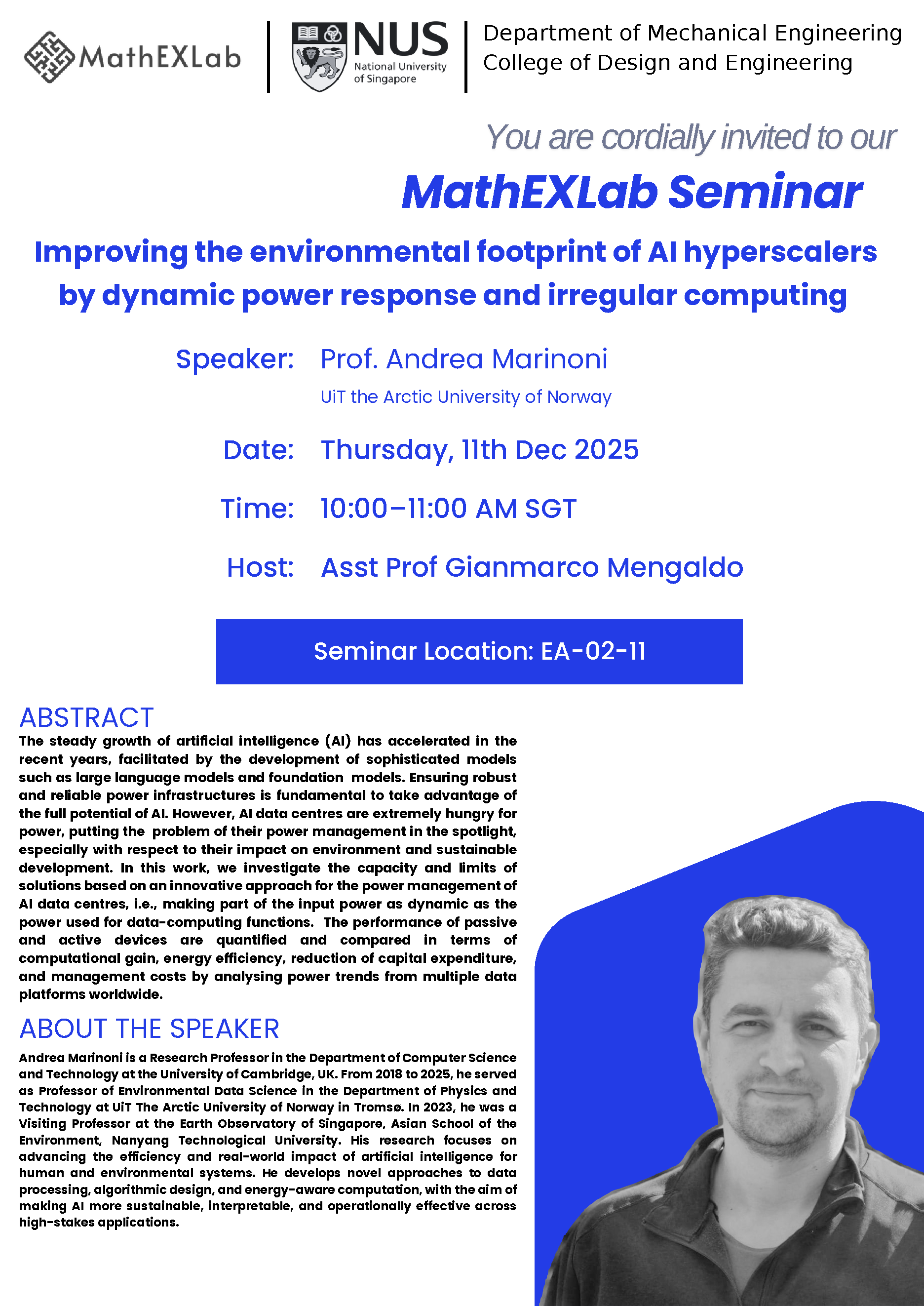
Improving the Environmental Footprint of AI Hyperscalers by Dynamic Power Response and Irregular Computing
Prof Marinoni addressed the sustainability challenges posed by energy-intensive AI data centres and hyperscalers.
Seminar Details
- Speaker: Prof Andrea Marinoni
- Date: Thursday, 11 December 2025
- Time: 10:00 am to 11:00 am (SGT)
- Location: EA-02-11
Abstract
- The seminar examined a power-management approach in which part of the input power becomes dynamically responsive to computing demands, and compared passive and active strategies in terms of computational gains, energy efficiency, reduced capital expenditure, and operational cost.
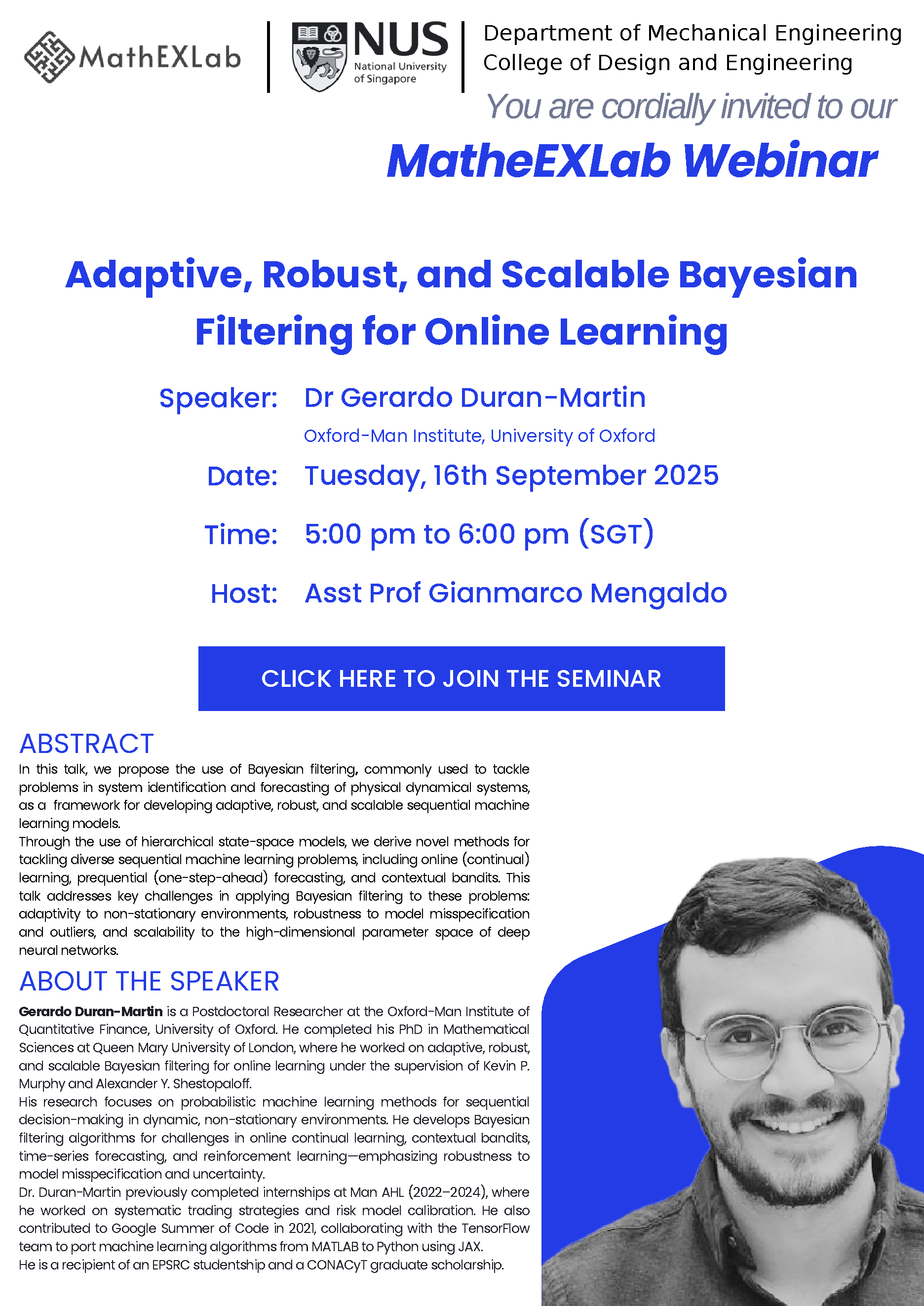
Adaptive, Robust, and Scalable Bayesian Filtering for Online Learning
This webinar proposed Bayesian filtering as a framework for sequential machine learning in dynamic environments.
Seminar Details
- Speaker: Dr Gerardo Duran-Martin
- Date: Tuesday, 16 September 2025
- Time: 5:00 pm to 6:00 pm (SGT)
- Format: Webinar
Abstract
- It focused on how hierarchical state-space models can support online learning, forecasting, and contextual bandits while addressing practical challenges such as non-stationarity, robustness to misspecification and outliers, and scalability to the high-dimensional parameter spaces of deep neural networks.
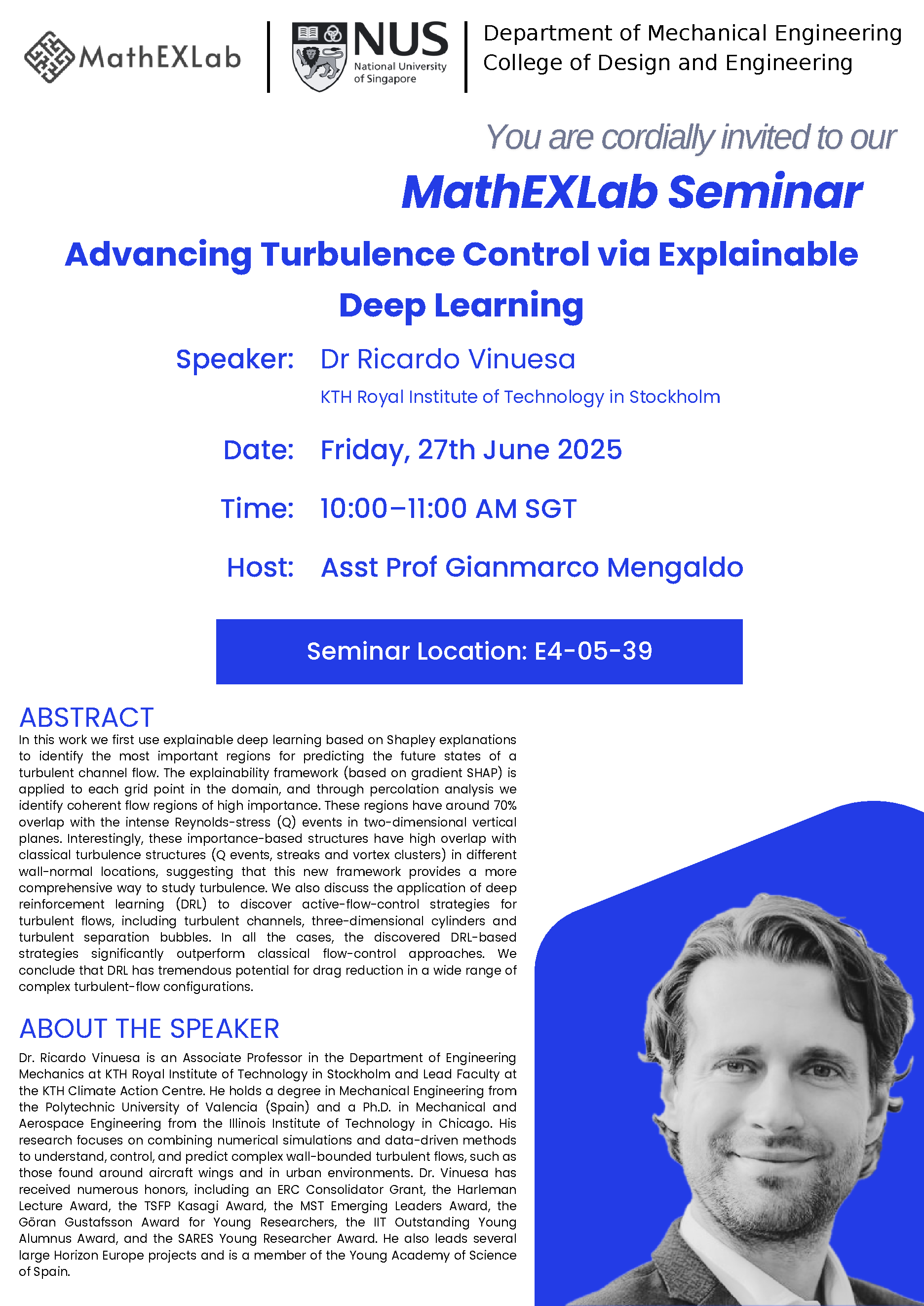
Advancing Turbulence Control via Explainable Deep Learning
Dr Vinuesa showed how Shapley-based explainable deep learning can reveal the coherent regions that are most important for predicting future turbulent flow states.
Seminar Details
- Speaker: Dr Ricardo Vinuesa
- Date: Friday, 27 June 2025
- Time: 10:00 am to 11:00 am (SGT)
- Location: E4-05-39
Abstract
- He also discussed how deep reinforcement learning can outperform classical active flow-control strategies across several turbulent configurations, highlighting the promise of AI-guided control for drag reduction.
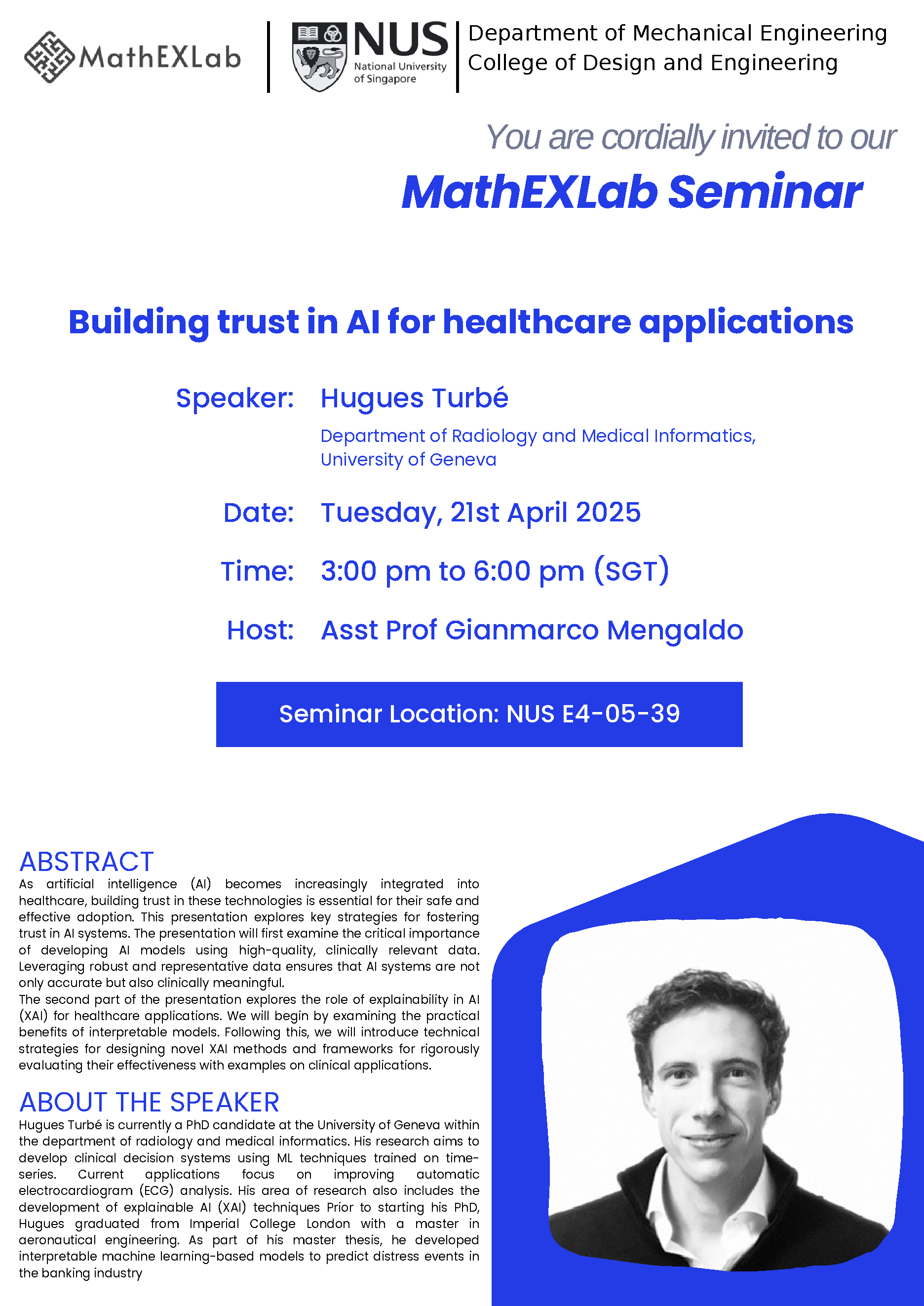
Building Trust in AI for Healthcare Applications
Hugues Turbe discussed what it takes to build trust in AI systems for healthcare, with emphasis on high-quality clinically relevant data and rigorous explainability methods. The seminar connected interpretable modelling and evaluation frameworks to concrete clinical applications, including time-series decision support and automated ECG analysis.
Seminar Details
- Speaker: Hugues Turbe
- Date: Tuesday, 21 April 2025
- Time: 3:00 pm to 6:00 pm (SGT)
- Location: NUS E4-05-39
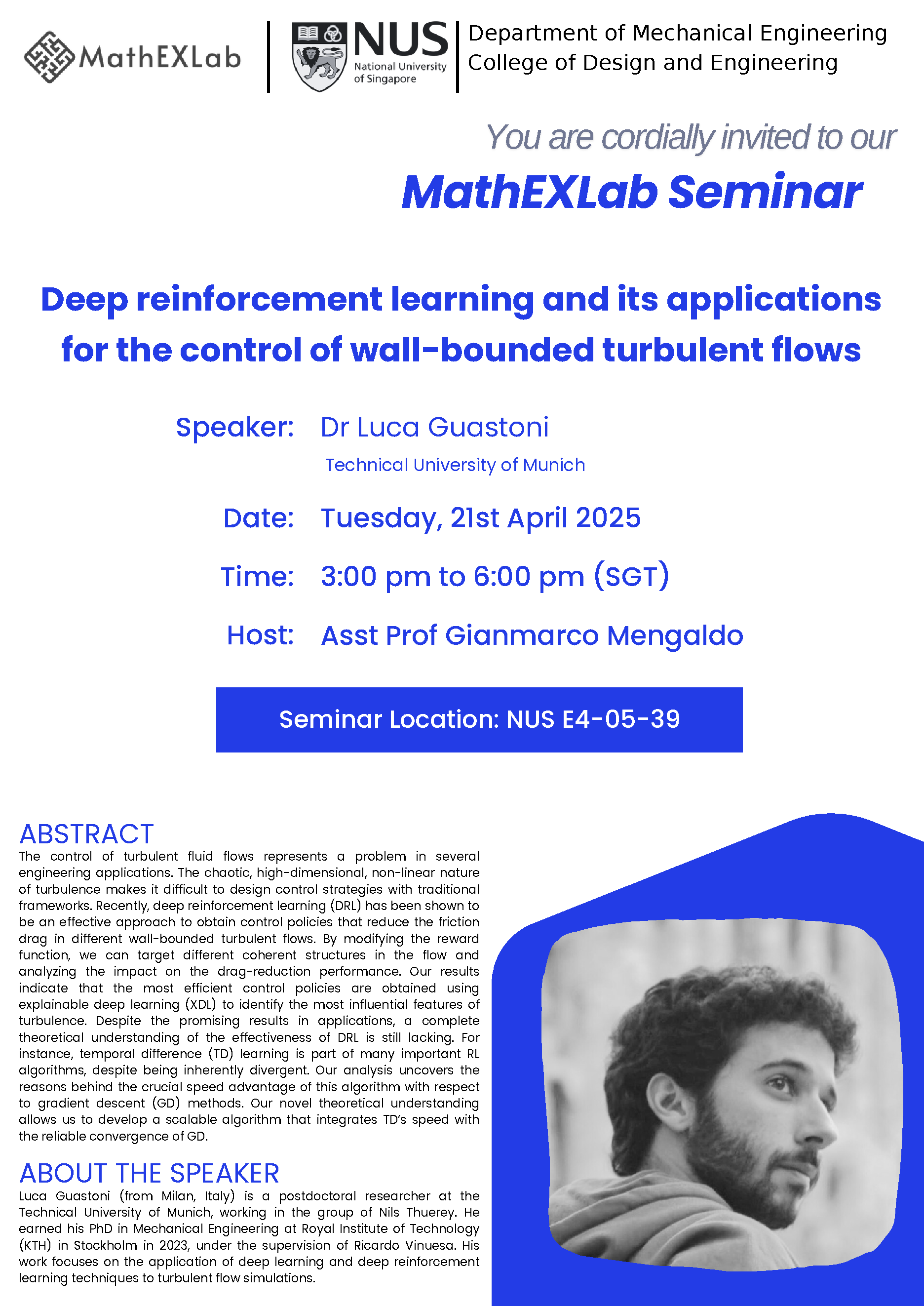
Deep Reinforcement Learning and Its Applications for the Control of Wall-Bounded Turbulent Flows
This talk explored how deep reinforcement learning can be used to control turbulent flows in engineering settings where traditional control strategies struggle. It showed how explainable deep learning can identify the flow features that matter most for drag reduction, and it also presented theoretical insights into why temporal-difference learning can be both fast and effective in reinforcement learning for complex fluid systems.
Seminar Details
- Speaker: Dr Luca Guastoni
- Date: Tuesday, 21 April 2025
- Time: 3:00 pm to 6:00 pm (SGT)
- Location: NUS E4-05-39
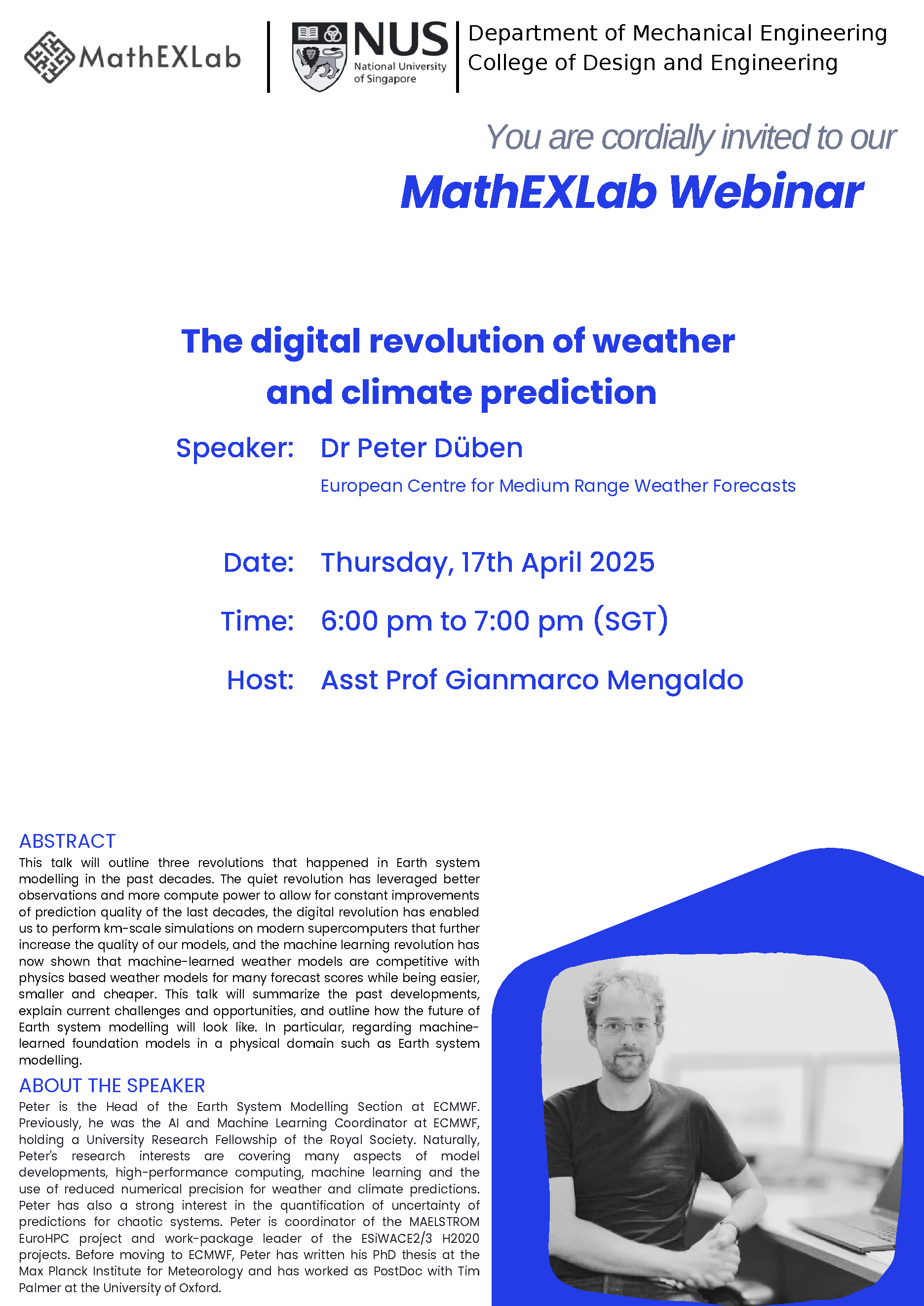
The Digital Revolution of Weather and Climate Prediction
This seminar traced three major shifts in Earth system modelling: steady improvements from better observations and compute, the move to kilometre-scale simulation on modern supercomputers, and the emergence of machine-learned weather models. The talk also discussed current challenges and the growing role of foundation models in physically grounded weather and climate prediction.
Seminar Details
- Speaker: Dr Peter Duben
- Date: Thursday, 17 April 2025
- Time: 6:00 pm to 7:00 pm (SGT)
- Format: Webinar
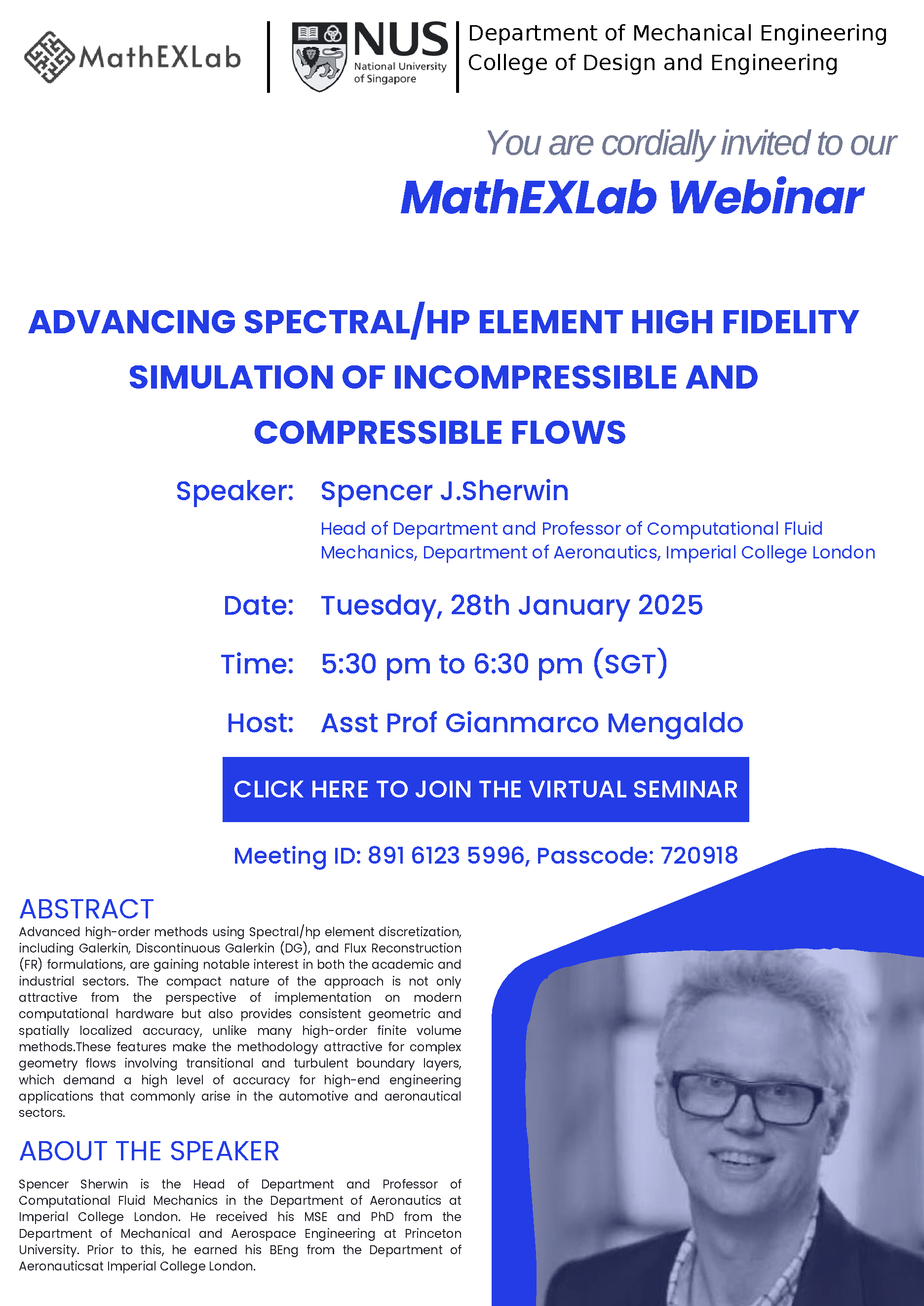
Advancing Spectral/hp Element High Fidelity Simulation of Incompressible and Compressible Flows
Prof Sherwin presented modern high-order spectral/hp element methods for incompressible and compressible flow simulation, including Galerkin, discontinuous Galerkin, and flux reconstruction formulations. The talk focused on why these methods are attractive for complex geometries and turbulent boundary-layer problems that require both geometric flexibility and high numerical accuracy in demanding engineering applications.
Seminar Details
- Speaker: Prof Spencer J. Sherwin
- Date: Tuesday, 28 January 2025
- Time: 5:30 pm to 6:30 pm (SGT)
- Format: Virtual Webinar
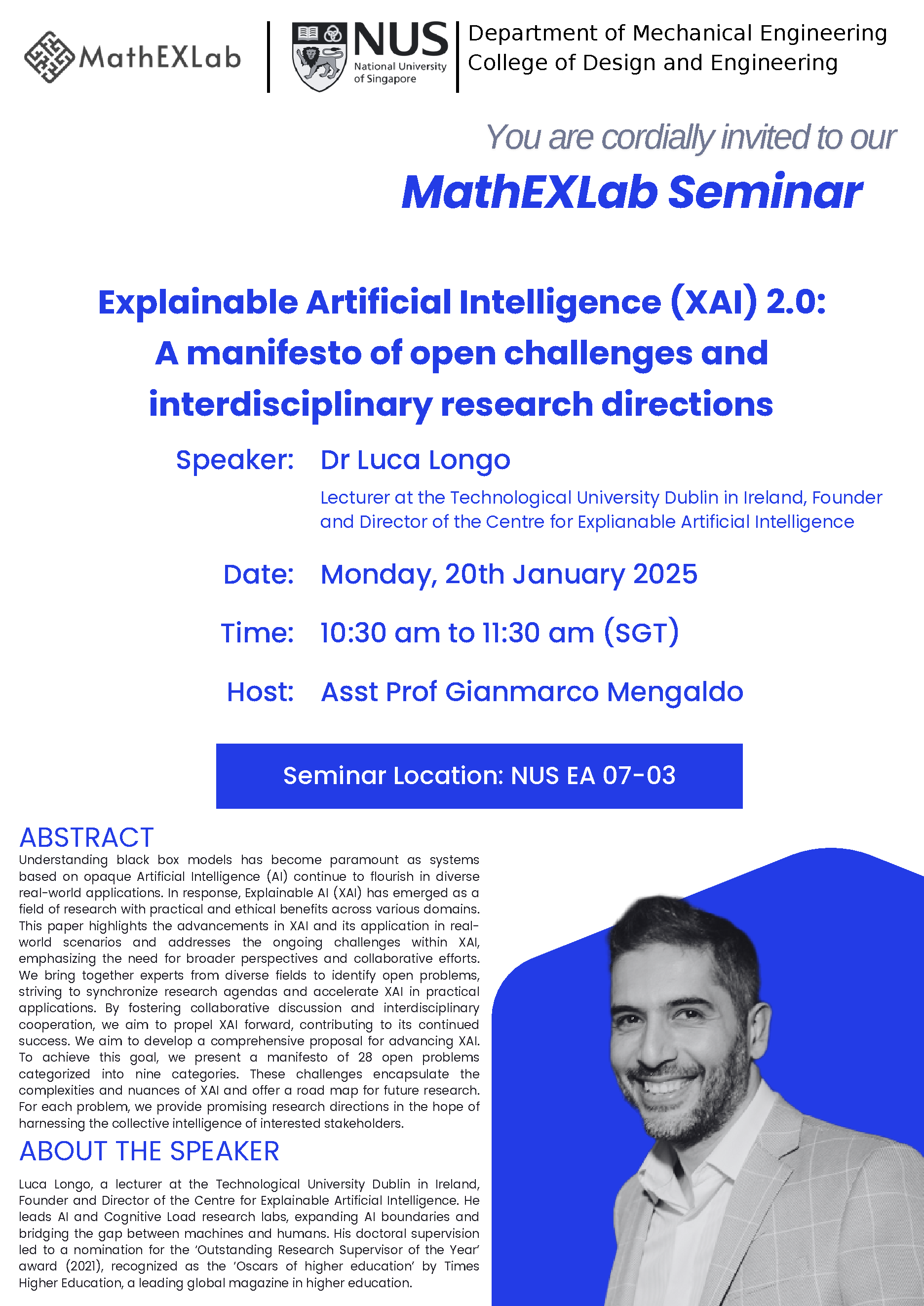
Explainable Artificial Intelligence (XAI) 2.0: A manifesto of open challenges and interdisciplinary research directions
This seminar examined the current state of explainable AI and argued for a broader, more interdisciplinary research agenda. It highlighted key practical and ethical challenges in understanding black-box systems, introduced a manifesto of 28 open problems across nine categories, and outlined research directions for moving XAI toward more reliable real-world deployment.
Seminar Details
- Speaker: Dr Luca Longo
- Date: Monday, 20 January 2025
- Time: 10:30 am to 11:30 am (SGT)
- Location: NUS EA 07-03